- Raynaud's disease is a condition that effects small arteries and vessels causing them to become narrow and limit the blood supply to those area's effected.
- Raynaud's symptoms can include decreased temperature, discoloration, and numbness to various extremities.
- Raynaud's disease only affects about 3 percent of the general population.
- Although people of any age can have Raynaud’s disease, the primary form typically begins between the ages of 15 and 25.
- When Raynaud’s disease is caused by or associated with an underlying disease, it typically begins after 35 to 40 years of age.
- For most people, Raynaud's disease can be easily managed with simple medication, but in severe forms can be treated with various types of surgeries or chemical injections.
Wednesday, October 19, 2011
Facts About Raynaud's Disease

Tuesday, October 18, 2011
All these nasty nails
Listed below are some nail conditions caused by injury, infection, or lack of nutrition, ect:
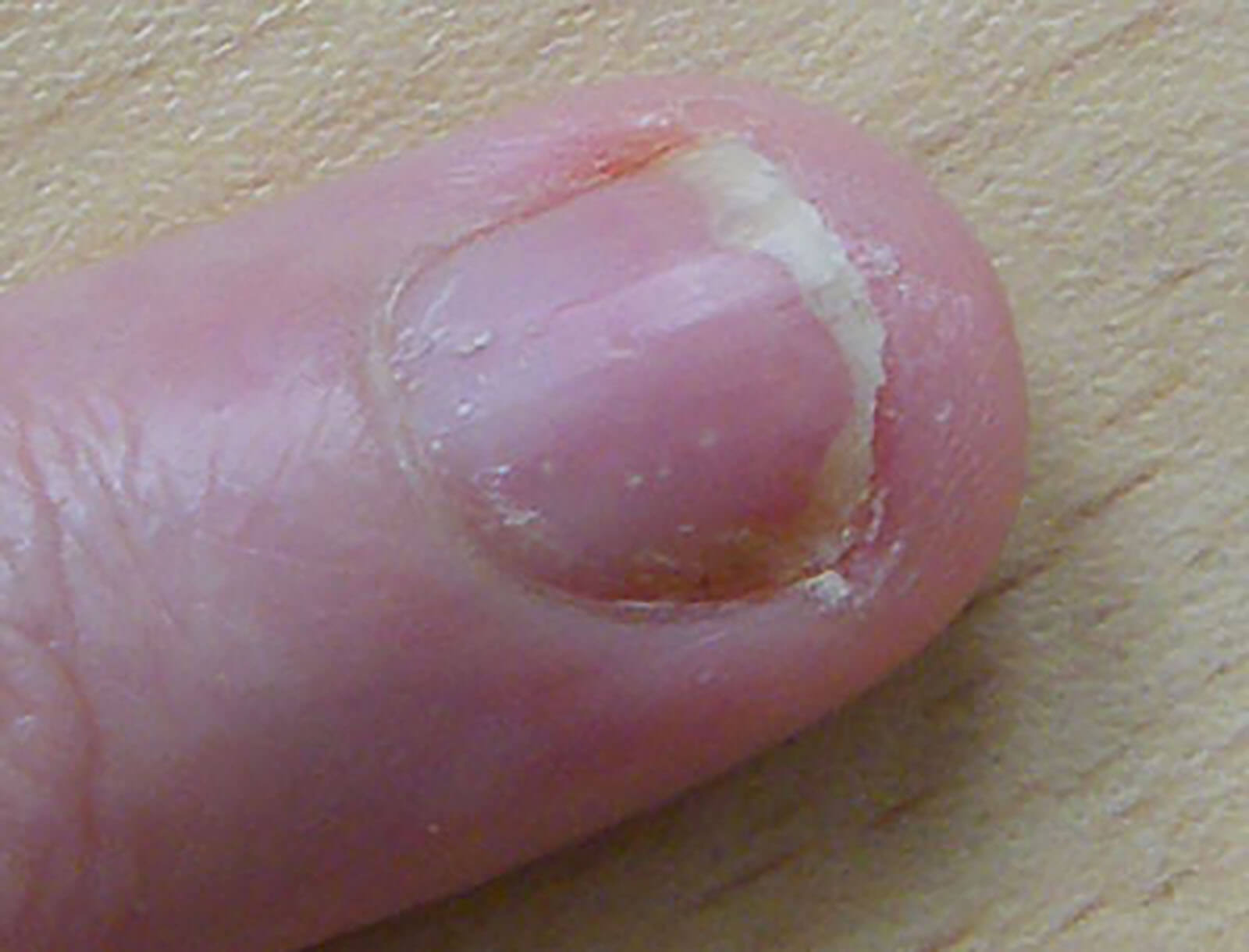
Onycholysis: This separation disturbance is also called “plummer nails”. The way that this disturbance happens is by blood separating the nail from its bed when hit or injured. This particular process might result in nail discoloration.

Clubbing: this is a nail deformity that is caused by thickening of the proximal tissue under nail which causes the nail to shape itself as if it was rounded towards the tip of the nail, making an appreance of a rounded nail.
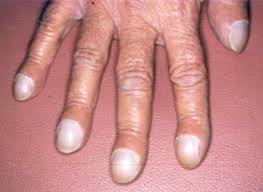
Koilonychias: This is a disorder in which the nail appears to be shaped with a depression rather than a radius. This actual nail state can correct itself with time but doesn’t always result in a normal nail shape. This is cause because of the nail patella which contorts the nails form during the nails process of growing.
 http://www.google.com/imgres?q=onycholysis&hl=en&gbv=2&biw=1366&bih=574&tbm=isch&tbnid=w8-gluCI3qVcdM:&imgrefurl=http://www.healthsci.jmu.edu/common/Knitter/Graphics/dermatology/&docid=N51V8kBRVVV2aM&imgurl=http://www.healthsci.jmu.edu/common/Knitter/Graphics/dermatology/Onycholysis%252520TCN.jpg&w=600&h=471&ei=es6cTq6RNIaUiAL2xND1CQ&zoom=1&iact=rc&dur=178&sig=116936205452691783240&page=1&tbnh=112&tbnw=158&start=0&ndsp=12&ved=1t:429,r:6,s:0&tx=56&ty=60
http://www.surgicalnotes.co.uk/content/finger-digital-clubbing
http://www.picturesdepot.com/medical/18751/koilonychia.htmlhttp://www.aafp.org/afp/2004/0315/p1417.html
while the nails continue to grow they have to confront some of these obsticles:
Pitting: pitting is something that places indents within the keritanzed surface of the nails which is usually caused by diseses. usually the common desease that this disorder does hand and hand with psoriasis.
Splinter hemorrhages: they are caused by the growth of the nail and they are lines that follow the growing nail.They are caused by the veins by the nailo which burst and clot. 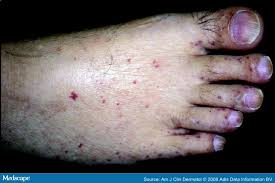
http://www.nlm.nih.gov/medlineplus/ency/article/003283.htm
http://www.aafp.org/afp/2004/0315/p1417.html
http://psoriasistreat.org/action.php
http://www.google.com/imgres?q=splinter+hemorrhages&hl=en&gbv=2&biw=1366&bih=574&tbm=isch&tbnid=Bs0IGq4lOT-YzM:&imgrefurl=http://www.medscape.com/viewarticle/588087_6&docid=X199Ks0hrj1AaM&imgurl=http://img.medscape.com/fullsize/migrated/588/087/amjd588087.fig11.jpg&w=723&h=483&ei=182cTurjE8PgiALD_JH4CQ&zoom=1&iact=rc&dur=70&sig=116936205452691783240&page=1&tbnh=117&tbnw=185&start=0&ndsp=12&ved=1t:429,r:12,s:0&tx=66&ty=32
Stroke
The Basics
- A stroke occurs when a blood clot blocks an artery or a blood vessel breaks, interrupting blood flow to an area of the brain.
- Brain cells begin to die and brain damage occurs.
- Abilities such as speech, movement and memory are lost.
http://www.stroke.org/site/PageServer?pagename=stroke
Types of Strokes
- Ischemic Stroke
-Most common type of stroke
-caused by a clot or other blockage within an artery leading to the brain
- Intracerebral Hemorrhage
- caused by the sudden rupture of an artery within the brain
-Blood is released into the brain compressing brain structures.
- Subarachnoid Hemorrhage
- caused by the sudden rupture of an artery
-differs from an intracerebral hemorrhage
-leads to blood filling the space surrounding the brain rather than inside of it
http://www.webmd.com/stroke/guide/stroke-symptoms-types
Controlling risk factors for stroke
- Have regular medical checkups
- Control high blood pressure
- For diabetics, keep blood sugar levels as close to normal
- Control any disorders that effect blood vessels
- Take cholesterol-lowering medications if you have high cholesterol
- Don't smoke
- Limit alcohol
- Stay at a healthy weight
- Be active
http://answers.webmd.com/answers/1192533
Signs that indicate that a person is having a stroke
- Sudden numbness or weakness of the face, arm, or leg (one side of the body)
- Sudden confusion
- Trouble speaking or understanding speech
- Trouble seeing in one or both eyes
- Sudden trouble walking, dizziness, loss of balance or coordination
- Sudden severe headache with no known cause
Pimple Wimple c(^_^)
The term used for inflammatory skin disease is called ANCE VULGARIS.
It affects about 85 percent to 100 percent of us in our lifetime.
Lesions like this are because there is a change in skin cell units, known as pilosebaceous that contains sebaceous glands.
A breakout or lesions occur when dead or oil skin cells are being clogged.
The areas on the skin that contains most of the sebaceous glands, will most likely have the breakouts to occur.
It affects about 85 percent to 100 percent of us in our lifetime.
Lesions like this are because there is a change in skin cell units, known as pilosebaceous that contains sebaceous glands.
A breakout or lesions occur when dead or oil skin cells are being clogged.
The areas on the skin that contains most of the sebaceous glands, will most likely have the breakouts to occur.
Monday, October 17, 2011
Shingles-The Disease on Par with Chicken Pox!
Shingles is a disease that is caused by the virus called varicella zoster; the virus is also the cause of chicken pox.


- Shingles are not contagious and will most likely affect people 50 years or older of age because of their weak immune systems.
- The symptoms are sometimes mistaken for another illness, and they feel a shooting pain, or some kind of burning, numbness, tingling, or itching in one area of the body, or face.
- Rashes and blisters could cause an outbreak, but outbreaks could occur without the rashes or blisters.
a Genetic Disease.
ECTODERMAL DYSPLASIA! or in other words, E.D.
*What is the cause of this disease, you ask?
E.D. is caused by altered genes! They can be inherited by a parent or just mutate from a normal gene.
*What occurs to your body if you have E.D?
- Abnormal or Missing Finger or Toe Nails.
- Inability To Sweat
- Sparse, Thin Hair on the Scalp and Body.
*Who is trying to treat E.D.?
Because of the many different forms of E.D., a special ectodermal dysplasia clinic held at USCF's Center for Craniofacial Anomalies (facial disorders), several times a year. This clinic includes our regular team of specialists plus a dermatologist and a prosthodontist.
*How do you treat Ectodermal Dysplasia?
There is no treatment, but there are clinics you may attend for testing. Things That Help: wear a wig and dentures to improve look, take & cool baths to keep a normal temperature.
*Is there anyway a person could die from Ectodermal Dysplasia?
E.D. can eventually lead to death, by brain damage cause by increased body temperature. And also, it can lead to seizures by high fever, known as "febrile seizures".
http://emedicine.medscape.com/article/1110595-overview
*What is the cause of this disease, you ask?
E.D. is caused by altered genes! They can be inherited by a parent or just mutate from a normal gene.
*What occurs to your body if you have E.D?
- Abnormal or Missing Finger or Toe Nails.
- Inability To Sweat
- Sparse, Thin Hair on the Scalp and Body.
*Who is trying to treat E.D.?
Because of the many different forms of E.D., a special ectodermal dysplasia clinic held at USCF's Center for Craniofacial Anomalies (facial disorders), several times a year. This clinic includes our regular team of specialists plus a dermatologist and a prosthodontist.
*How do you treat Ectodermal Dysplasia?
There is no treatment, but there are clinics you may attend for testing. Things That Help: wear a wig and dentures to improve look, take & cool baths to keep a normal temperature.
*Is there anyway a person could die from Ectodermal Dysplasia?
E.D. can eventually lead to death, by brain damage cause by increased body temperature. And also, it can lead to seizures by high fever, known as "febrile seizures".
http://emedicine.medscape.com/article/1110595-overview


Subscribe to:
Comments (Atom)